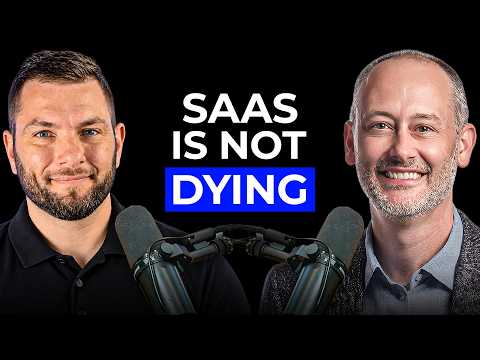
Dynamics 365 and the case for SaaS in the AI era
Technical Specialist, Business Applications at Microsoft.
Samuel Boulanger’s conversation with Microsoft’s Bryan Goode argues that AI agents could make business applications more important, not less.
Key insights
- Bryan Goode argues that speeding up individuals does not fix inefficient business processes.
- The episode describes employees as “human middleware” moving information between disconnected systems.
- Goode discusses when to use pre-built Dynamics 365 agents versus building in Copilot Studio.
- The conversation covers multi-agent orchestration, human approval and IT visibility across agents.
- L&G and Lifetime are named as examples of organizations rethinking processes with AI.
Samuel Boulanger’s episode of The AI Frontier Playbook features Bryan Goode, Microsoft’s Corporate Vice President for Business Applications and Agents. The conversation examines why AI may reshape, rather than eliminate, business applications. Its central argument is that automating individual tasks is not enough: organizations need to rethink the processes that connect people, information and systems.
What's new
Goode’s case is that the value of business software is not limited to the screens employees use. As AI agents take on more work, applications can remain important as sources of data, business rules and governance. That perspective challenges the “SaaS apocalypse” argument that agents will make traditional software platforms unnecessary.
The episode description frames a common workplace problem as employees acting as “human middleware.” People carry information from one system to another, switching between applications to complete a process. The description also refers to a “toggle tax,” saying it can cost the average information worker around four hours a week; the published description does not explain how that figure was calculated.
The discussion also covers practical choices for organizations building agent-based processes. It contrasts pre-built Dynamics 365 agents with agents built in Copilot Studio, and introduces multi-agent orchestration: connecting agents as part of a broader business process. L&G and Lifetime are cited as examples of organizations that rethought customer service and order fulfillment with AI.
Why it matters
For business leaders and process owners, the distinction between making a task faster and redesigning a process is consequential. A faster handoff still leaves the handoff in place; a redesigned process aims to reduce unnecessary transfers between systems and people. The episode’s focus is therefore on business outcomes, not simply adding an assistant to each employee’s existing workflow.
For admins and IT teams, Goode’s argument places renewed emphasis on the foundations behind an application: data, permissions, rules and governance. If agents are expected to act across systems, organizations need to consider what information they can access and which actions they can take. The description says the conversation covers Agent 365 as a way for IT to gain visibility across agents in an organization, but it does not provide product details or explain its controls.
For makers, the pre-built-versus-custom choice is a useful decision point. A packaged Dynamics 365 agent may fit a task already addressed by a supplied agent; Copilot Studio is discussed as the route for building an organization’s own agent. The published material does not give a feature-by-feature comparison, so it cannot establish which option fits a particular process or what licensing either requires.
How it works
The episode description outlines an approach based on process change rather than isolated automation. It emphasizes selecting an initial process, choosing an appropriate sponsor and tracking a metric consistently. It also argues for combining bottom-up experimentation with top-down process change, while assigning ownership of the process outcome to the business rather than IT alone.
- Choose a process to improve. Start with work that involves avoidable movement between systems or manual coordination, rather than assuming that an AI tool is the goal.
- Decide whether to use a packaged agent or build one. The conversation compares Dynamics 365’s pre-built agents with custom agents in Copilot Studio, but the description does not supply selection criteria beyond raising the choice.
- Connect the work across agents where needed. Multi-agent orchestration is presented as a way to connect agents into one business process. The description does not specify technical configuration or supported integrations.
- Set boundaries for human involvement. The discussion addresses where human approval remains necessary as agents begin taking actions. The description does not list particular approval points or decision types.
- Measure the process outcome. The episode recommends selecting a metric and following it relentlessly, with the business owning the result.
This outline is useful as a way to frame a pilot, but it is not a configuration guide. The source does not show screens, agent-building steps, policy settings or a detailed implementation example. Readers looking for those mechanics will need more than the published episode description.
Limitations and open questions
The available material is the video’s published description, not a complete transcript. It lists subjects covered and summarizes Goode’s position, but does not provide the full exchange, demonstrations, named agent capabilities or detailed explanations of the L&G and Lifetime examples. As a result, the examples can be reported as cases the episode discusses, not as independently verified implementation outcomes.
Important operational questions remain unanswered in the description. It does not specify licensing, availability, rollout stage, security configuration, the exact scope of Agent 365, or how multi-agent orchestration handles failures and handoffs. It also does not identify the four-hour estimate’s source or methodology, so readers should not treat that number as a universal benchmark.
The broad takeaway is a strategic argument, not a guarantee that every SaaS product will gain value from agents. Whether the approach works in a given organization depends on its processes, data and controls; the episode description does not supply enough detail to evaluate those factors for a specific deployment.
Sources
Frequently asked questions
Does the episode say AI agents will replace Dynamics 365?
No. The episode presents the opposing argument: business applications may remain important because agents depend on their data, processes and governance.
When should an organization use a pre-built agent or Copilot Studio?
The conversation compares pre-built Dynamics 365 agents with agents built in Copilot Studio. The published description does not give detailed criteria for choosing between them.
What does the episode say about human approval?
It discusses where people still need to approve actions as agents take on work. The description does not name specific actions or approval rules.
Does the source explain licensing or availability?
No. The published description does not state licensing requirements, rollout stage or availability.