Azure DataCenter
Timespan
explore our new search
Databases
Aug 5, 2026 3:03 PM
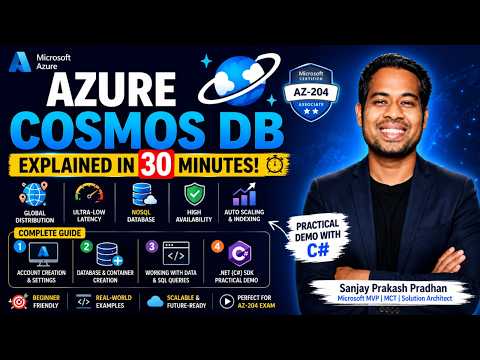
Azure Cosmos DB: 30-Min Beginner Guide
by HubSite 365 about Softchief Learn
Learn how to take advantage of your business data with Microsoft Dynamics 365 & Power Platform & Cross Technologies. My name is Sanjaya Prakash Pradhan and I am a Microsoft Certified Trainer (MCT) and
Microsoft expert guide to Azure Cosmos DB NoSQL global distribution automatic scaling low latency .NET C# CosmosClient
Key insights
- Azure Cosmos DB: A fully managed, globally distributed database service from Microsoft that supports NoSQL, relational, and vector workloads.
It delivers low latency, high availability, and elastic scale for cloud-native apps. - Global distribution: Replicate data across regions with multi-region writes and SLA-backed availability.
This design gives applications single-digit millisecond responses for users worldwide. - NoSQL and multi-model: Store schemaless JSON documents and use multiple APIs including PostgreSQL, MongoDB, and Cassandra, plus vector support for AI workloads.
Query data with SQL-like syntax or the API that matches your app. - Request Units (RU/s): The currency for throughput and performance in Cosmos DB that affects cost and latency.
Choose provisioned, serverless, or autoscale modes to match workload needs. - Partition key: A required design choice that drives scalability and query performance.
Pick a key that balances data and request load across containers and partitions. - SDK & CRUD: Use CosmosClient SDKs (for example C#/.NET) to create accounts, databases, containers, and perform CRUD operations and queries.
These practical skills are important for developers and AZ-204 exam preparation.

Keywords
Azure Cosmos DB tutorial, Cosmos DB for beginners, Azure NoSQL database guide, Cosmos DB quick guide, Learn Azure Cosmos DB, Cosmos DB performance tuning, Cosmos DB indexing strategies, Cosmos DB exam preparation